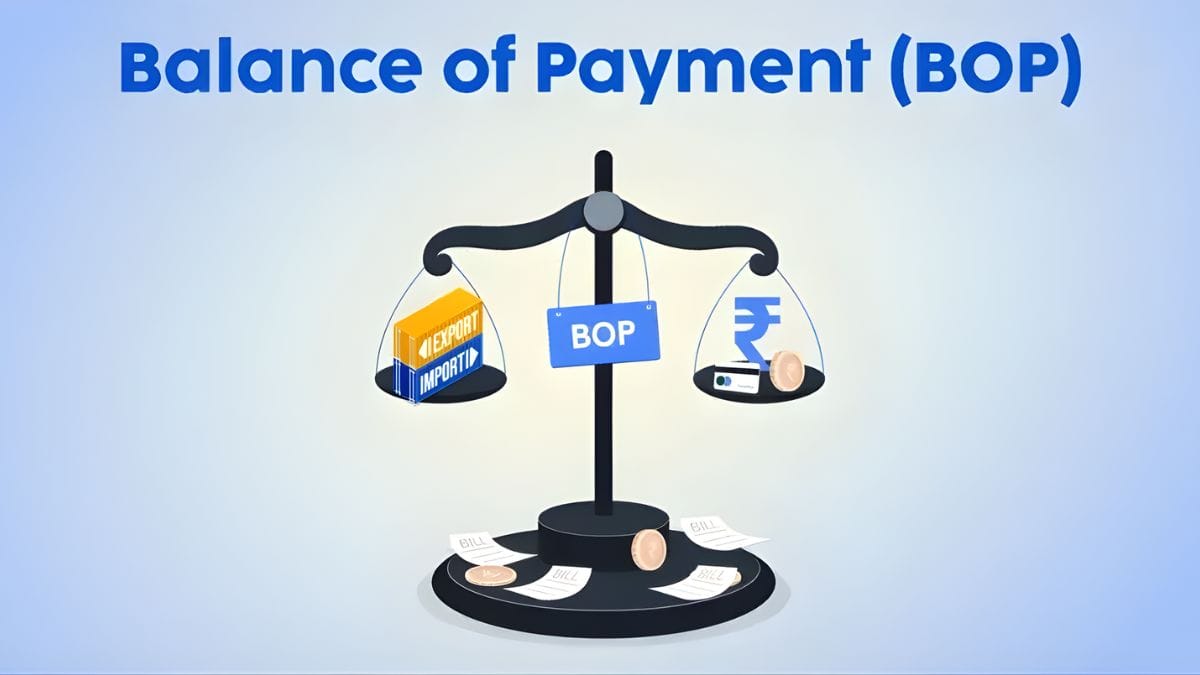
Ever wondered how a country keeps track of all the money flowing in and out across its borders? That’s where the Balance of Payments (BoP) comes into play. It’s like a country’s financial diary, recording every rupee, dollar, euro, or yen that enters or leaves — whether from trade, tourism, investments, or aid.
Let’s break it down in simple terms so you can finally understand how the balance of payments works and why it’s such a big deal for any economy.
Meaning
The Balance of Payments (BoP) is a statement that records all economic transactions made between one country and the rest of the world over a specific time period — usually quarterly or annually.
Think of it as a financial report card. It shows how much money is coming in (credits) and how much is going out (debits). It includes trade in goods and services, cross-border investments, loans, remittances, and more.
Structure
The BoP is divided into three main accounts:
1. Current Account
This section covers day-to-day transactions.
Includes:
- Exports and imports of goods (visible trade)
- Services like IT, tourism, transport (invisible trade)
- Remittances and income from abroad
- Interest and dividend payments
If exports are more than imports, the country has a current account surplus. If it imports more than it exports, it shows a deficit.
2. Capital Account
This is a smaller section, recording capital transfers and acquisition or disposal of non-produced, non-financial assets (like patents, copyrights, land).
Examples:
- Debt forgiveness
- Transfer of ownership of fixed assets
3. Financial Account
This tracks investments and assets moving in and out of the country.
Includes:
- Foreign direct investment (FDI)
- Portfolio investments (stocks and bonds)
- Reserve assets (foreign currency, gold)
- Loans and banking capital
Basically, it’s all about how money is invested and borrowed across borders.
Formula
While the BoP technically should balance (every debit has a credit), economists usually track it using this formula:
BoP = Current Account + Capital Account + Financial Account + Errors & Omissions
If there’s a mismatch, it shows up under Errors and Omissions — like accounting adjustments.
Example
Let’s say India:
- Exports goods worth $100 billion
- Imports goods worth $120 billion
- Gets $20 billion in remittances
- Receives $15 billion in FDI
- Invests $5 billion in foreign assets
Then the current account is:
($100B exports + $20B remittances) – $120B imports = $0 (Balanced)
And financial account surplus is:
$15B FDI – $5B investment = $10B net inflow
If everything adds up properly, the BoP is in balance. If not, the central bank uses foreign exchange reserves to settle the difference.
Importance
Why should you care about BoP? It tells us a lot about a country’s economic health.
- Deficit: If BoP shows a large deficit, the country may be borrowing too much or losing foreign reserves.
- Surplus: A surplus means more money is coming in than going out — good, but too much can also signal low imports or reduced domestic demand.
- Currency Value: BoP impacts exchange rates. A deficit can weaken a currency, while a surplus can strengthen it.
- Investor Confidence: A balanced BoP reflects stability, which attracts foreign investment.
Deficit vs Surplus
Here’s a quick comparison table:
| Feature | BoP Deficit | BoP Surplus |
|---|---|---|
| More imports or outflows | Yes | No |
| Currency value | May depreciate | May appreciate |
| Investor view | Risky | Stable or positive |
| Govt response | May hike interest rates or restrict imports | May ease policies |
How Countries Fix BoP Deficits
If a country is constantly in BoP deficit, here’s what it might do:
- Borrow from IMF or other countries
- Use forex reserves to stabilize currency
- Increase export incentives
- Reduce imports through tariffs or restrictions
- Raise interest rates to attract investment
Central banks like RBI keep a close eye on BoP while planning monetary and trade policies.
Knowing the balance of payments helps us connect the dots between trade, investment, currency value, and economic stability. Whether you’re a student, investor, or just curious — knowing how money flows into and out of a country gives you a clearer picture of the global economy.
FAQs
What is balance of payments in simple words?
It’s a record of all money a country earns and spends globally.
What are the 3 parts of BoP?
Current Account, Capital Account, and Financial Account.
What happens if BoP is in deficit?
It may lead to currency depreciation and foreign borrowing.
Is BoP always balanced?
Yes, in accounting terms, but imbalances exist between sections.
Who prepares the BoP in India?
The Reserve Bank of India (RBI) prepares and publishes BoP data.