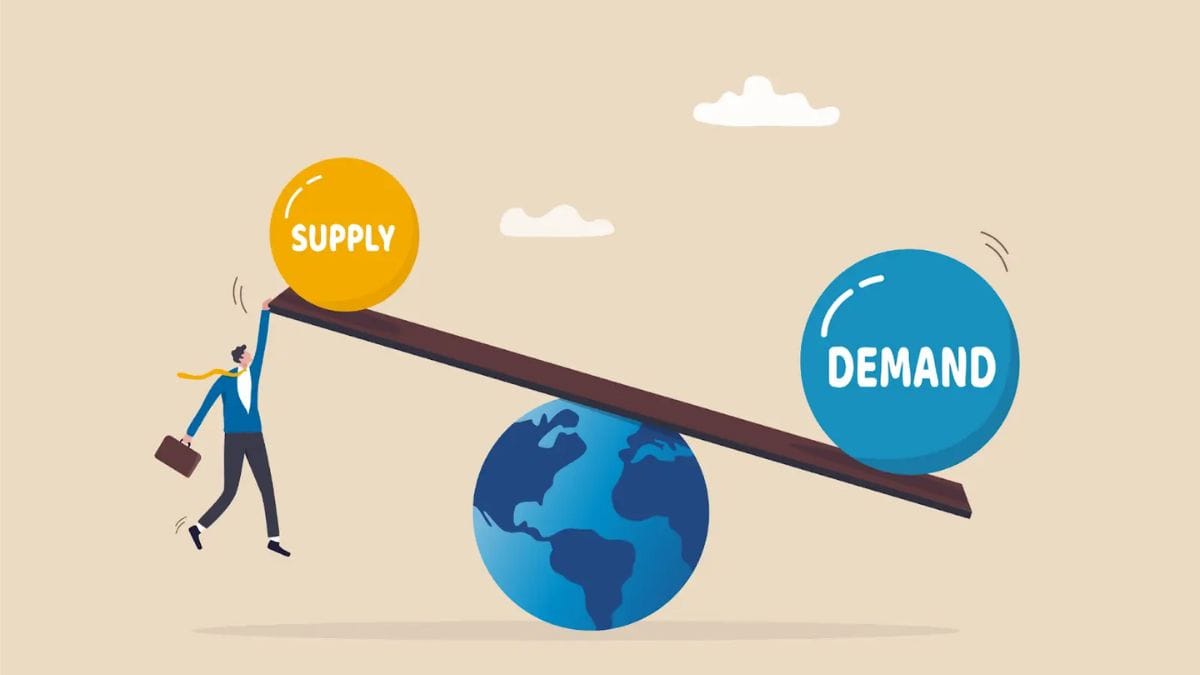
Demand and supply are the foundation of economics. Almost every economic idea, from price rise to shortages and market trends, connects back to these two forces.
Whether you are a student, a competitive exam aspirant, or just someone curious about how prices are decided, knowing demand and supply makes the world easier to read. It explains why vegetables get expensive in the rainy season or why mobile phone prices fall after a few months.
Let’s break this basic economic concept in a simple, practical, and easy-to-remember way.
Meaning
Demand refers to how much of a good or service consumers are willing and able to buy at a given price during a specific time period. Supply refers to how much of that good or service producers are willing and able to sell at a given price during a specific time period.
In simple words, demand comes from buyers and supply comes from sellers. Price is the meeting point where both sides agree. Think of a weekly village market. Buyers want low prices, sellers want high prices, and the final price settles somewhere in between.
Demand
Demand is not just about wanting something. It also includes the ability to pay for it. For example, many people may want a luxury car, but only those who can afford it create real demand.
When the price of a product falls, demand usually increases. When the price rises, demand usually decreases. This relationship is called the law of demand.
For example, if the price of rice falls, families may buy extra rice. But if rice becomes very expensive, they may reduce consumption or switch to alternatives.
Factors
Demand does not depend only on price. Several other factors influence it.
Income plays a big role. When income rises, people buy more goods. Tastes and preferences also matter. If people start preferring healthy food, demand for junk food may fall. Population size, prices of related goods, expectations about future prices, and seasonal changes also affect demand.
Demand is like a mood. It changes with circumstances, habits, and expectations.
Supply
Supply refers to the quantity of a product that producers are ready to sell at different prices. Unlike demand, supply usually increases when price rises. This is called the law of supply.
If the price of potatoes increases, farmers are encouraged to grow and sell more potatoes. If prices fall too much, they may reduce production or shift to other crops.
Supply reflects the producer’s motivation. Higher prices mean higher profit, which attracts more production.
Factors
Supply is influenced by production costs, technology, availability of raw materials, government policies, taxes, subsidies, and natural conditions.
For example, good rainfall increases crop supply, while floods reduce it. Improved machines increase supply by reducing cost. Government subsidies encourage production, while high taxes may discourage it.
Supply is like effort. When rewards increase, effort usually increases too.
Equilibrium
The most important idea in demand and supply is equilibrium. Equilibrium price is the price at which quantity demanded equals quantity supplied. At this point, the market is balanced.
If price is above equilibrium, supply exceeds demand, leading to surplus. Sellers then reduce prices. If price is below equilibrium, demand exceeds supply, leading to shortage. Prices then rise.
Markets naturally move toward equilibrium, just like water finding its own level.
Example
Let’s take a simple example of onions in West Bengal.
If onion prices rise sharply, consumers buy less and farmers sell more. This creates excess supply, forcing prices to fall. If prices fall too much, farmers reduce supply and consumers buy more, pushing prices up again.
This constant adjustment keeps the market moving toward balance.
Table
Here is a simple comparison table for clarity:
| Aspect | Demand | Supply |
|---|---|---|
| Meaning | Willingness to buy | Willingness to sell |
| Source | Consumers | Producers |
| Price Effect | Price up, demand down | Price up, supply up |
| Key Law | Law of Demand | Law of Supply |
This table shows how demand and supply work in opposite directions but together shape the market.
Importance
Demand and supply help explain price changes, shortages, surpluses, and market trends. Governments use these concepts to frame policies, set minimum prices, and control inflation. Businesses use them to decide production levels and pricing strategies.
For students, demand and supply form the base for advanced topics like elasticity, market structures, and macroeconomics.
Knowing this concept is like learning the alphabet before forming words.
Demand and supply may sound simple, but they quietly control daily life. From food prices to fuel rates and even job salaries, these two forces work behind the scenes. Once you know them, economics stops feeling abstract and starts feeling logical. It becomes less about memorizing definitions and more about observing real life.
FAQs
What is demand in economics?
Demand is willingness and ability to buy goods.
What is supply in economics?
Supply is willingness and ability to sell goods.
What is equilibrium price?
It is where demand equals supply.
Does price affect demand?
Yes, higher price usually lowers demand.
Why is demand and supply important?
They explain how prices are determined.