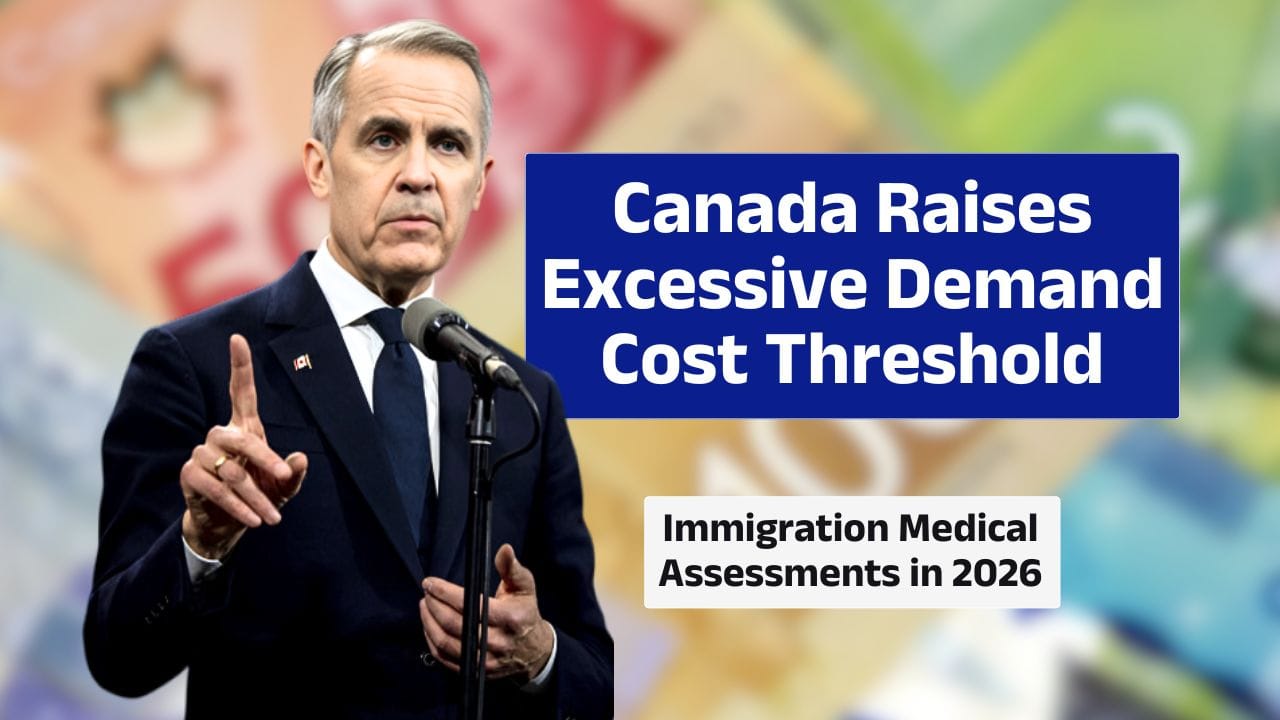
In 2026, Canada increased the excessive demand cost threshold, a key benchmark used by Immigration, Refugees and Citizenship Canada (IRCC) to evaluate medical admissibility. This threshold determines whether a foreign national’s health condition could place a burden on Canada’s publicly funded health or social services.
Though rarely discussed, the excessive demand clause can be one of the most decisive factors in an immigration application. It applies across various immigration pathways—permanent, temporary, and family-based—and continues to be misunderstood by many applicants.
This article outlines what changed in 2026, who’s affected, and what immigration applicants need to know when navigating medical admissibility rules.
Definition
Medical inadmissibility refers to conditions under which a person is denied entry to Canada based on health grounds. According to the Immigration and Refugee Protection Act (IRPA), a foreign national may be found inadmissible if their condition is likely to:
- Endanger public health
- Endanger public safety
- Cause excessive demand on health or social services
This third category—excessive demand—is a cost and system capacity test, and is the focus of the 2026 update.

Update
The new excessive demand cost threshold for 2026 is:
| Period | Threshold |
|---|---|
| 5 years | $144,390 |
| Annual average | $28,878 |
This is an increase from the 2025 threshold of $135,810 over 5 years (or $27,162 annually), reflecting a 6.3% increase year-over-year.
This benchmark is used by medical officers to evaluate whether the projected costs of health or social services for an applicant exceed what is considered acceptable.
Impact
The threshold is not a fee. It is used to assess the expected cost of publicly funded medical or social services tied to an applicant’s health condition.
There are two ways an applicant can be found inadmissible on excessive demand grounds:

- Cost-based: The projected cost of required services exceeds the threshold.
- Wait-time-based: The services required would worsen wait times for Canadians or permanent residents in a way that leads to poorer health outcomes.
Applicants whose cases fall into either category may face a medical refusal.
Applicability
Medical inadmissibility assessments may apply to:
- Temporary residents (students, workers, visitors), especially if a medical exam is required
- Permanent residence applicants, including those applying via Express Entry, PNPs, business immigration, or some family categories
- Accompanying and non-accompanying family members, depending on the program
Even if the principal applicant is admissible, a dependent’s inadmissibility can affect the entire application.
Evaluation
Medical assessments are based on clinical evidence, including:
- Immigration Medical Exam results
- Prognosis and diagnosis reports
- Prescribed treatments and their cost
- Likelihood of needing institutional or long-term care
- Publicly funded services required
The cost calculation is typically made by IRCC’s medical officers, who are guided by law to exclude personal intent or financial ability to cover costs unless those factors fall within permitted mitigation criteria.
Services
Health services may include:
- Specialist consultations
- Publicly funded pharmaceuticals
- Diagnostic services
- Hospital or institutional care
Social services are more narrowly defined:
- Residential or institutional care
- Services funded primarily by public programs
- Supports prescribed by a licensed health professional
Not every publicly available support service counts toward the excessive demand calculation.
Examples
| Scenario | Estimated Cost | 5-Year Projection | Likely Outcome |
|---|---|---|---|
| Medication & services at $30,000/year | $30,000 | $150,000 | Exceeds threshold, may trigger inadmissibility |
| Services at $25,000/year | $25,000 | $125,000 | Below threshold, cost grounds less likely |
In both cases, wait times and service impact may still affect the outcome.
Exemptions
The following applicants are not subject to excessive demand assessments:
- Refugees and protected persons
- Sponsored spouses, common-law partners, and dependent children in family class
- Some humanitarian and compassionate cases, depending on discretion
However, public health and safety risks may still apply to these categories.
Process
If IRCC identifies a potential medical inadmissibility issue, they issue a procedural fairness letter. This is not a refusal, but a formal opportunity to respond.
Applicants are generally given 90 days to reply, and may request an extension. You can respond with:
- Updated medical evidence
- Revised treatment costs
- Clarifications on service usage
- A mitigation plan, where permitted
Mitigation
A mitigation plan is a detailed document explaining how the applicant will avoid creating excessive demand. This may include:
- Use of private insurance (only in approved contexts like outpatient medication)
- Plans to fund services privately
- Financial documentation
- Signed declarations of ability and intent
Important: You cannot simply opt out of public healthcare in Canada to avoid inadmissibility. The system assumes universal access, and most services cannot be bypassed.
Checklist for Mitigation Plan:
- Clear outline of needed services
- How services will be delivered
- Payment method
- Financial stability proof
- Signed declaration of ability and willingness
Misconceptions
Several false assumptions persist:
- “If I’m healthy enough to work, I can’t be refused” – Incorrect. The issue is projected public cost and service impact, not work ability.
- “Private insurance solves everything” – Not true. Only certain services (e.g., outpatient drugs) qualify for consideration.
- “I can just promise not to use services” – Promises are not accepted; the system uses medical evidence, not intention, to evaluate cases.
Canada’s 2026 excessive demand cost threshold of $144,390 over 5 years affects how medical admissibility is assessed for immigration applications. While the increased threshold provides slightly more leeway, the risk of refusal remains for applicants whose health conditions result in high-cost, long-term use of publicly funded services.
Knowing what IRCC evaluates—and responding to procedural fairness letters with strong, well-documented mitigation plans—is crucial. While this area remains complex, being proactive and informed can make the difference between approval and refusal.
FAQs
What is the 2026 excessive demand threshold?
$28,878 per year or $144,390 over 5 years.
Does private insurance prevent inadmissibility?
Not always – it helps in limited cases, like some medications.
Can family members be affected?
Yes, a dependent’s inadmissibility can affect the main application.
What triggers a procedural fairness letter?
Concerns about excessive demand from IRCC medical officers.
Are refugees subject to excessive demand rules?
No, they are exempt from cost-based excessive demand assessments.